

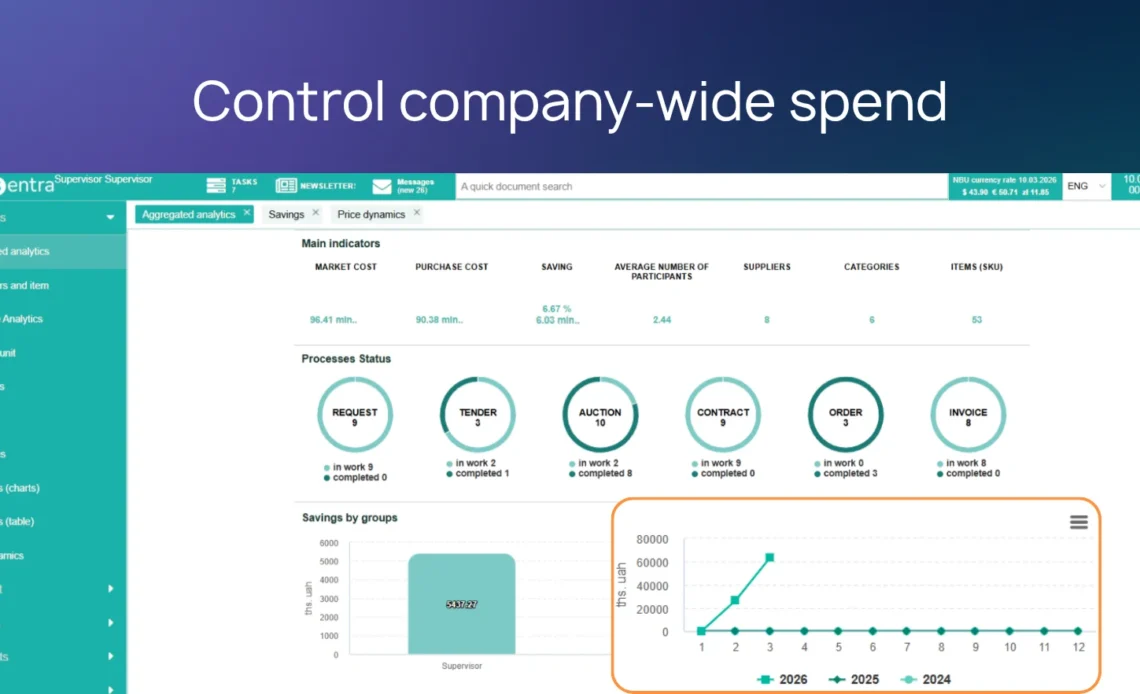
The enterprise procurement category is dealing with a crisis that B2B tech leaders know well: too many disconnected tools, dirty data, AI that cannot deliver on its promise, and no single view of what is actually happening. APSentra enters North America with $129B in managed spend and a governance-first architecture that sounds familiar to anyone who has tried to unify a fragmented tech stack.
If you work in marketing technology, you know this story by heart.
An enterprise runs seven, ten, maybe fifteen tools across the stack. Each captures data in its own format, uses its own identifiers, and reports against its own metrics. Nobody has a single view of the customer journey. AI initiatives get greenlit with fanfare, hit the data-quality wall at speed, and quietly get deprioritized. Leadership asks why the stack is not delivering ROI. The honest answer — that you cannot get signal from noise — is difficult to say out loud.
Now transpose that problem to procurement. Same architecture, different function. A large organization runs purchase requests through email, manages contracts in a shared drive, tracks supplier relationships in a spreadsheet, feeds commitment data to the ERP manually, and reconciles spend in a quarterly reporting exercise that no one fully trusts. When the CFO asks for real-time visibility into what has been committed before it leaves the business, the honest answer is: it does not exist.
APSentra, a global source-to-pay platform that has just expanded into North America, was built to solve procurement’s version of the fragmented-stack problem. And its approach — unify the data environment first, govern the workflow second, apply AI third — maps almost exactly to the playbook that the most mature martech organizations have learned through painful experience.
The Data Problem Is the Same Problem
APSentra’s own community polling — conducted across procurement and supply chain professionals — produced a finding that will surprise nobody who has run an AI initiative in a martech context: the leading reason procurement AI initiatives fail is poor data quality. Fragmented workflows came second. Lack of cross-functional alignment came third.
The sequence is instructive. Organizations see AI delivering real value in well-resourced technology environments and immediately want that value in procurement. They procure an AI layer, point it at their existing data, and discover that the data is not a dataset — it is a collection of disconnected inputs from a dozen different systems, each maintained with different levels of rigor, none of them reconciled in real time.
Sharon Custer, Founder of Inventory Optimization Pro and a contributor to APSentra’s “Behind Procurement” webinar series, puts it plainly: “If it’s garbage in, it’s garbage out. Building a clean and trusted data foundation is more achievable than ever — but it requires the willingness to confront the underlying mess first.”
This is precisely what the martech industry learned — expensively — about CDPs, attribution platforms, and AI-driven personalization tools over the past several years. The technology does not create the data quality. A unified, governed data environment creates the data quality. The technology then delivers on its potential.
The Architecture: Governance Before Automation
APSentra’s platform is built around a concept the company calls a digital twin of the organizational structure. Before the platform goes live, the entire organizational hierarchy — every approval authority, every budget line, every supplier pool, every cost center — is modeled inside the system to reflect how the business actually operates.
This is the procurement equivalent of the identity resolution and data governance layer that underpins an effective martech stack. It is not the exciting part. It is not what gets featured in the demo. But it is what makes everything else work.
When that structural model is in place, every purchase request that enters the system is automatically validated against live budget data, routed through the correct approval chain, and documented in a single auditable record. There are no manual checks because the governance is embedded in the workflow itself. Spend does not get committed without authorization because authorization is a property of the transaction, not a separate downstream process.
The output is a single source of truth — one connected record of every procurement action across the organization, from initial request through supplier selection, contract execution, order, delivery, and payment. Procurement teams, finance functions, and executive leadership all work from the same data, without a reconciliation step in between.
For B2B technology leaders who have spent years advocating for a unified customer data strategy, the architecture will feel intuitive. The principle is identical: get the data environment right, embed governance into the way data flows, then build intelligence on top of a foundation that can actually support it.
Where AI Fits in a Governed Environment
Once the data environment is unified and governed, APSentra applies AI to do what AI does well when the underlying conditions are right: study patterns at scale, surface anomalies that would be invisible in a manual review, model spend behavior, and improve decision quality before commitments are made.
The platform uses AI to flag when a supplier’s pricing has moved outside historical norms, when a procurement pattern across business units suggests consolidation opportunity, or when a commitment is being structured in a way that historically correlates with delivery issues. These are not outputs that any single procurement professional could generate manually across a large organization. They are outputs that only become possible when the data flowing through the system is clean, consistent, and complete.
This is the AI deployment model that works: not AI deployed on top of fragmented data in the hope that the model will compensate for the mess underneath, but AI deployed on top of a governed data environment as the intelligence layer it was designed to be.
Maurizio Dizan, VP of Professional Services and Customer Success at EBS SoundTrack, captures the sequence accurately: “Before any integration begins, organizations need to map processes, align stakeholders, and understand their data structure. AI transformation is not plug-and-play — but when done properly, the results are powerful.”
The B2B Expansion Story
APSentra enters North America with a track record that procurement and finance leaders on both sides of the Atlantic will find credible: more than 130 enterprise clients, $129 billion in managed spend, over two million procurement requests processed, more than 386,000 tenders managed, approximately $16 billion in verified savings generated, and a customer satisfaction rate above 94 percent.
The platform is ERP-agnostic — integrating with existing financial infrastructure including bidirectional SAP connectivity — and deploys in a structured five-stage process that typically takes up to eight weeks. Its client base spans financial services, telecommunications, logistics, energy, and infrastructure.
For B2B technology buyers evaluating the platform, the relevant comparison is not to traditional procurement tools that automate tasks. It is to the class of enterprise platforms — CRM, CDP, marketing automation at its most mature — that treat the data environment as the product, and automation and AI as the value layer that a well-structured environment makes possible.
“Behind Procurement”: Content-Led Community Building
APSentra has also launched “Behind Procurement,” a biweekly live webinar series hosted by CEO and Co-Founder Natalie Eksi. The series brings together senior practitioners and independent experts to discuss procurement trends, applied research, and case studies — with consistent attention to the intersection of data discipline, AI adoption, and financial performance.
For martech professionals, the content strategy is recognizable: build a practitioner community around real expertise, not product marketing. Create a regular cadence of peer-level conversations that elevate the function and expand the audience. Position the platform as the infrastructure that serious practitioners use.
Sessions run every second Thursday at 10 a.m. EST. Details on upcoming episodes are available through APSentra’s platform and via Natalie Eksi’s LinkedIn profile.
More information on the platform, integration capabilities, and North American availability is at apsentra.com.